EP_19014_2004 |
||
|
|
MEI Students' Study Trip 2019
STUDY TRIP TO THE EUROPEAN INSTITUTIONS
December
02 to 07, 2019 With a generous support and coordination by the Deutsche Stiftung fur Internationale Rechtliche Zusammenarbeit – IRZ, the MEI students, generation 2018/2019, had an extraordinarily useful and valuable opportunity to visit almost all important European institutions, and to obtain internal insights, new knowledge, and an innovative academic and professional experience. The study trip lasted from December 3 to December 8, 2019.
On Tuesday December 3rd, the group first arrived at the
Council of Europe.
After an introductory lecture from the ECRI, we had a presentation
of the Istanbul Convention and the work of the Council of Europe on
preventing and combating violence against women and domestic
violence. Some crucial points were made in the mentioned field, the
most important being the lack of education not only among civilians
and older people, but also among those working in the police and the
institutions that provide help to the victims. The gender equality
division of the Council expressed their worries regarding the fact
that women are still not getting adequate help in the 21st century.
The criteria for women's rights isn't being met still. They
accentuated the fact that many courts seem to underestimate the
rigidity of the laws that protect women, so we still have some
questionable judgments in those cases. They explained how the
Convention was being applied in different countries and how far
they've come from the beginnings. All in all, the lecture was highly
educational and it met all the standards in the way of spreading
information and necessary knowledge regarding this particular and
sensitive field. We left the room more worried, but also more
determined to be a part of the change.
Next, we had a
chance to attend a presentation dedicated to HELP: an e-learning
platform on human rights. To begin with, the platform contains a
huge variety of resources on the ECHR. They are available online and
translated into several languages. The data on this platform is
being constantly updated, so one can keep up the pace with the
ongoing evolution of information. We were told that the platform
offers 2 types of courses. On one hand: distance-learning courses
targeted at selected groups of legal professionals, and on the
other: self-learning resources, which were put in the spotlight, and
which provoked the most interest among the listeners. Simply having
an account on this platform enables a user to access all the
resources for self-learning it provides. Furthermore, the platform
also provides a wide range of advantages to its users. Some of these
are: it is free of charge, interactive, one can choose the topic of
his or her own interest and is not obliged to access all the topics
and do all the exercises related to these, etc. Nevertheless, once
the course completed, this platform provides us with a statement
proving that we managed to complete the course, and that we possess
certain knowledge of the topics covered. We had a chance to ask
questions regarding the functioning of the platform and we obtained
clear, direct and concise answers. In addition to that, some of the
listeners even managed to make their own account and to see then and
there what it looks like to use this platform. It is useful for
students, but also for anyone interested in ECHR topics.
In the afternoon, the group visited the European Court of Human
rights
and met with
Professor Lubarda, now judge of the European Court of Human Rights.
The judge welcomed us in Strasbourg and spoke about the unfolding of
a single case from the moment it enters the Court. He also explained
that every judge needs to be familiar with each case. He told us
about three cases – two of them were related to surrogacy and one
was related to religious discrimination.
On Wednesday, December 4th, the group
visited the European Court of Human Rights. We attended a hearing in the
case of Mugemangango v. Belguim (application No. 310/15). The case concerns a
post-electoral dispute relating to the current Belgium system:
Mr. Mugemangango alleged in particular that the procedure for the
examination of the complaint which he lodged with the Wallon
Parliament (the same body in relation to which the elections were
held) to challenge the result of election was not accompanied by the
minimum procedural safeguards against arbitrariness, inter alia
because the Wallon Parliament was the only body with jurisdiction to
determine his complaint. The case was heard by the
Grand Chamber, and Denmark and Venice Commission where allowed to
intervene as the third parties. By attending this hearing,
our MEI group was able to see in practice not only the procedural
steps in a case before the ECHR but also to get acquainted with the
general atmosphere in the court and courtroom.
In the afternoon, the group visited the European
Parliament.
The group took a tour through the building, aided by brochures and
electronic guides with details about each part of the building. The
last floor holds the Grand Chamber of Legislation, and on the second
floor, in a small projection hall, an 8-minute film about the
historical background and the activities of the European Parliament
was being played. There were also devices that offered simple,
informative games that at the same time provided a fun and
educational experience.
On Thursday, December 5th, the group
visited the Court of Justice of the European Union.
We attended the hearing in the case number C-74/19 Transportes
Aereos Portugueses, that refers to the air carrier invoking
extraordinary circumstances, regarding unruly passenger behaviour as
a cause. TAP as the air carrier in question denied
compensation for the flight delay (missed flight) having considered
the unruly passenger as an exonerating element – extraordinary
circumstance.
We were also
guided through the court building and given detailed facts about the
architecture and history of the Court.
The judicial
staff helped us understand the functioning of the Court and the way
the cases are assigned, as well as the multilinguistic aspect (how
the cases are translated), the cooperation between different
departments and the importance of lawyer linguists.
CJEU judge Marko Ilesic, a prominent teacher of commercial law from
the law school of Ljubljana, held the lecture, offering an
interesting, different perspective, afterwards engaging in a
fruitful discussion with the members of the group.
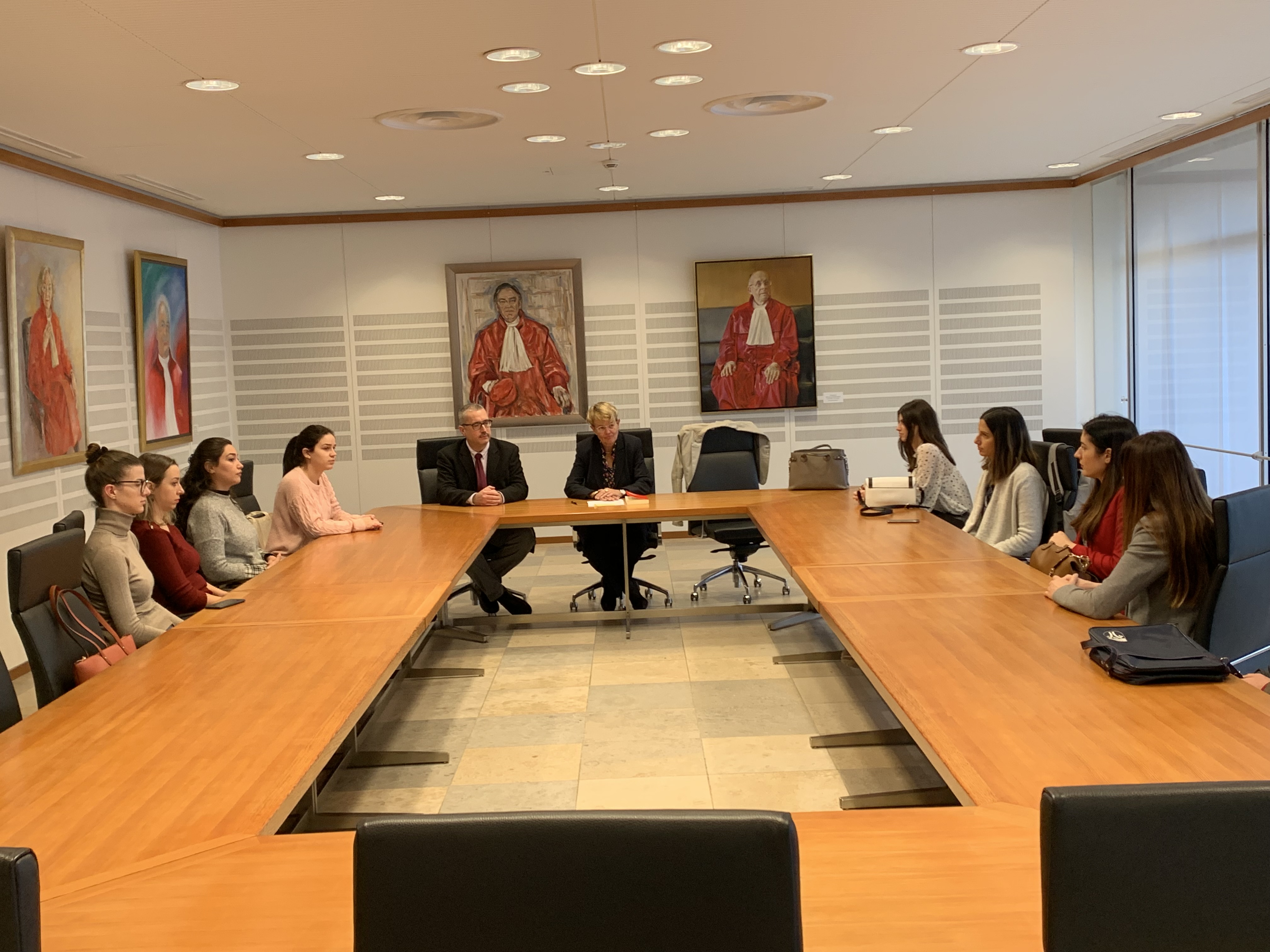
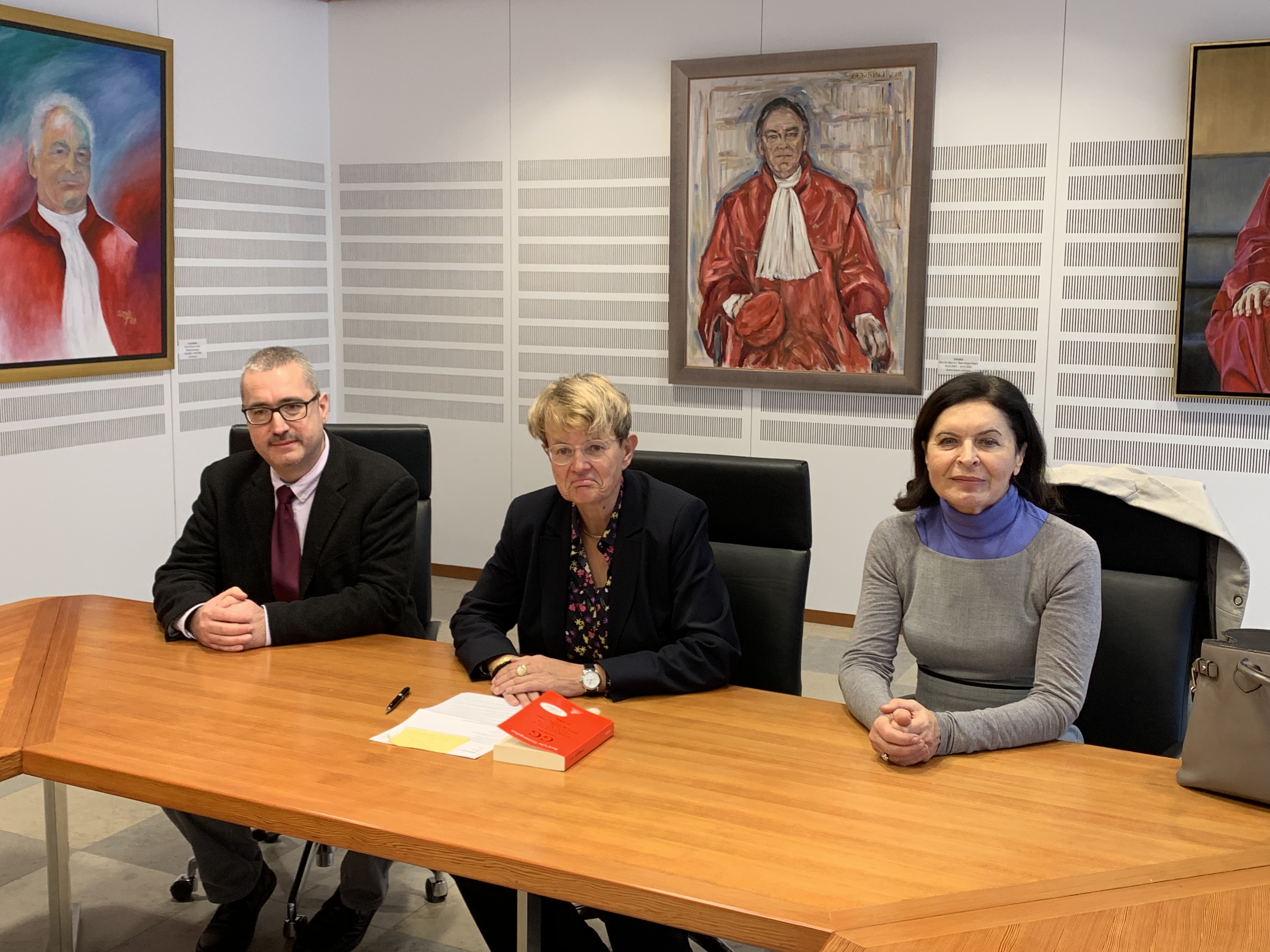
On Friday, December 6th, the group
visited the German Federal Constitutional Court.
After the meeting with judge Baer ended, the official part of the
study trip was over.
|
|
|
Faculty
of Law University of Belgrade |
||